Food manufacturers are always looking for ingredients that can deliver reliable performance while also meeting changing consumer preferences. Today, buyers want more than sweetness. They increasingly look for ingredients that offer a recognizable origin, simple processing, and a natural positioning. This is where coconut sugar granules for food manufacturing can become a practical ingredient choice. Coconut sugar granules come from the sap of coconut flower blossoms. Producers collect the sap, heat it to reduce its moisture, and process the resulting coconut sugar into granules. Unlike liquid sweeteners, granules are easy to weigh, blend, store, and transport. As a result, manufacturers can use them across many food applications.
For industrial buyers, however, choosing coconut sugar is not only about finding a natural sweetener. Consistent particle size, moisture, color, flavor, packaging, and supply capacity can all affect production. Therefore, working with the right coconut sugar supplier is an important part of successful sourcing.
What Makes Coconut Sugar Granules Useful in Food Manufacturing?
Coconut sugar granules are a dry sweetening ingredient made from concentrated coconut blossom sap. Depending on the production process, the final product can range from light golden brown to darker brown. It generally has a mild caramel-like flavor that can add more character than ordinary white sugar.
For food manufacturers, the granulated form offers several practical benefits. It can be measured by weight, incorporated into dry mixes, and combined with other powdered or granular ingredients. Manufacturers can also select different particle sizes depending on the application and production process.
Another advantage is handling. A dry granular ingredient is generally easier to move through a factory than a liquid sweetener. It can be packed in bulk bags or smaller food-grade packaging according to the buyer’s requirements. This makes coconut sugar granules suitable for manufacturers that need a flexible industrial sweetener.
However, coconut sugar should not automatically be treated as a direct one-to-one replacement for every sugar in every formulation. Its color, flavor, moisture, and particle characteristics can influence the finished product. Food technologists should therefore conduct product trials before changing a formulation at commercial scale.
Why Food Manufacturers Are Looking Beyond Conventional Sugar
Consumer interest in naturally positioned ingredients has encouraged food companies to explore alternatives to conventional refined sweeteners. This trend can be seen across bakery products, beverages, snack foods, sauces, desserts, and other processed foods.
Coconut sugar fits this conversation because its source is easy to explain. It is made from coconut blossom sap rather than being produced from sugar cane or sugar beet. For brands that want to communicate ingredient origin, this can provide a useful product story.
At the same time, manufacturers need to separate marketing claims from technical performance. A naturally sourced ingredient still needs to meet the company’s specifications for safety, consistency, moisture, particle size, and storage stability.
This is why sourcing decisions should involve both purchasing and production teams. Purchasing may focus on price, minimum order quantity, and delivery. Meanwhile, production and quality teams may focus on specifications, batch consistency, testing, and suitability for the finished product.
The best sourcing decision balances all of these requirements.
Coconut Sugar Granules in Bakery Ingredients
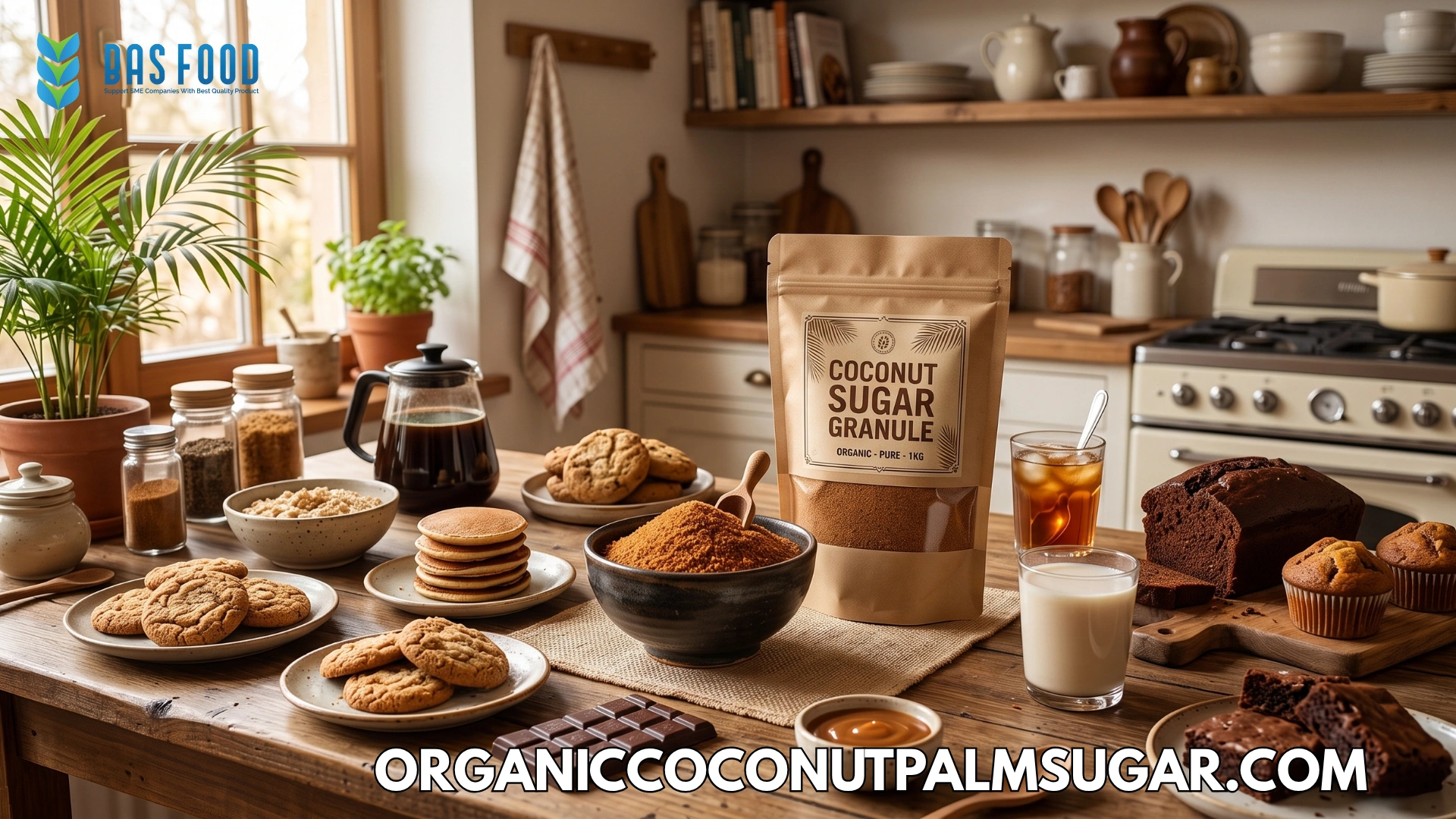
Bakery products are one of the most interesting applications for coconut sugar granules. Manufacturers can use them in cookies, cakes, muffins, biscuits, pastries, granola, and other baked products where brown color and caramel-like flavor are acceptable or desirable.
When used in bakery ingredients, coconut sugar can contribute sweetness while also influencing the color and flavor of the final product. In some formulations, this can create a richer sensory profile. It can work particularly well in products that already contain ingredients such as cinnamon, cocoa, nuts, oats, chocolate, or dried fruit.
Particle size also matters. Fine granules may disperse more quickly in some doughs and batters, while larger granules can behave differently during mixing. Therefore, manufacturers should specify the desired granule size when discussing requirements with a supplier.
Another important consideration is recipe adjustment. Replacing refined white sugar with coconut sugar may affect more than sweetness. It can influence color, texture, moisture interaction, and flavor. A controlled trial helps manufacturers determine the correct formulation rather than relying on a simple substitution ratio.
For commercial bakery production, consistency from batch to batch is especially important. A supplier that can provide clear product specifications and stable quality can make formulation management easier.
How Coconut Sugar Supports Different Food Processing Applications
Beyond baking, coconut sugar granules can be incorporated into many types of food processing. Manufacturers may use them in cereal products, snack foods, sauces, dessert mixes, confectionery, instant beverages, and dry premixes.
In dry food production, granules can be blended with ingredients such as flour, cocoa, spices, milk powder, cereal, or other sweetening components. The exact suitability depends on the recipe, mixing equipment, and desired product characteristics.
For beverage manufacturers, coconut sugar can be used in powdered drink mixes or other formulations where a dry sweetener is preferred. Manufacturers should evaluate dissolution behavior, especially when the final product needs to dissolve quickly in cold or room-temperature liquid.
Sauces and dessert applications can also benefit from the characteristic flavor of coconut sugar. The slightly caramel-like profile may complement products where a deeper sweetness is desired. However, the brown color should be considered when developing light-colored products.
For industrial production, ingredient functionality matters just as much as the ingredient story. Manufacturers should therefore evaluate coconut sugar based on the complete application rather than simply looking at its name or marketing appeal.
Choosing the Right Granule Size for Industrial Production
Particle size is one of the most important specifications when purchasing coconut sugar granules. Different food products may require different granule characteristics, and the right size can affect mixing, dissolution, processing speed, and final texture.
For example, a manufacturer producing dry beverage mixes may prefer relatively fine granules for easier dispersion. A bakery manufacturer may select a different size depending on the dough or batter. Meanwhile, certain food products may benefit from a more noticeable granular structure.
There is no universal granule size that works best for every factory. Instead, the ideal specification depends on the product and production equipment.
That is why buyers should discuss particle size with their coconut sugar supplier before placing a large order. A supplier should be able to explain available specifications and provide samples for testing where appropriate.
Sampling is particularly useful for new buyers. A production team can test the ingredient in its actual formulation and evaluate factors such as mixing, flavor, color, moisture behavior, and finished-product consistency.
Quality Specifications Matter at Commercial Scale
When purchasing coconut sugar for food manufacturing, buyers should look beyond appearance. A professional procurement process should consider several technical specifications.
Important factors may include:
- Product form and granule size
- Moisture level
- Color and appearance
- Flavor and aroma
- Foreign matter requirements
- Microbiological specifications
- Food safety requirements
- Packaging format
- Shelf life
- Storage conditions
- Batch consistency
- Documentation and certificates
These specifications help manufacturers establish clear purchasing requirements. They also reduce the risk of receiving material that performs differently from the ingredient used during product development.
For larger production operations, consistency becomes even more important. A formulation may work perfectly during initial trials but create problems if subsequent batches have significantly different characteristics.
Therefore, manufacturers should establish an agreed product specification before commercial purchasing. The supplier and buyer can then use the specification as a common reference for quality control.
Packaging and Storage for Coconut Sugar Granules
Packaging plays an important role in protecting coconut sugar during transportation and storage. Because coconut sugar is a dry product, exposure to moisture can affect its physical condition. Proper packaging helps maintain product quality throughout the supply chain.
Food manufacturers purchasing internationally should discuss packaging requirements before shipment. Depending on the order volume and production setup, buyers may require bulk packaging, food-grade bags, or customized packaging.
Storage conditions should also be considered. Coconut sugar should generally be kept in a clean, dry environment and protected from excessive humidity. Manufacturers should follow the storage recommendations provided in the supplier’s product documentation.
For exporters, packaging also needs to withstand handling during international transportation. A suitable packaging format can reduce the risk of leakage, contamination, moisture exposure, or physical damage.
This is another reason why buyers should evaluate the complete supply solution rather than comparing suppliers based only on the quoted price per kilogram.
What Food Manufacturers Should Ask a Coconut Sugar Supplier
Finding a reliable coconut sugar supplier starts with asking the right questions. Buyers should request product specifications and confirm whether the supplier can consistently meet those specifications.
Useful questions include:
- What granule sizes are available?
- What are the standard moisture specifications?
- What packaging formats are available?
- What is the minimum order quantity?
- Can the supplier provide product samples?
- What food safety documentation is available?
- What is the expected shelf life?
- How is each batch controlled?
- What is the supplier’s production capacity?
- Can the supplier support export orders?
These questions help procurement teams compare suppliers on more than price. They also give product development and quality teams the information they need before approving an ingredient.
For international buyers, communication is particularly important. An experienced coconut sugar exporter supplier should understand export documentation, packaging requirements, shipment planning, and the practical needs of overseas buyers.
A supplier that communicates clearly can make the sourcing process much easier, especially when the buyer needs customized specifications or regular shipments.
Why Working With an Experienced Coconut Sugar Exporter Matters
International food manufacturers often need more than a product. They need a dependable supply partner that understands the requirements of cross-border trade.
An experienced coconut sugar exporter supplier can help buyers manage the process from product selection to shipment preparation. This may include discussing specifications, packaging, order quantities, documentation, and shipping schedules.
For manufacturers, supply reliability is critical. A production line can be affected when an important ingredient arrives late or does not match the agreed specification. Therefore, supplier evaluation should consider production capability and communication as well as product quality.
This is where CV Bonafide Anugerah Sentosa can be considered by buyers looking for an Indonesian coconut sugar sourcing partner. As an exporter of coconut sugar and other coconut-derived products, the company serves the needs of international buyers seeking Indonesian-origin ingredients.
For buyers considering a new source, starting with samples and technical specifications is a practical approach. It allows the food manufacturer’s quality and R&D teams to evaluate the ingredient before moving into larger commercial orders.
Coconut Sugar Granules as a Flexible Industrial Sweetener
The food industry uses sweeteners in many different ways, so flexibility is valuable. Coconut sugar granules can serve as an industrial sweetener in applications where their flavor, color, and physical properties fit the formulation.
They can be incorporated into bakery products, dry mixes, snacks, desserts, beverages, sauces, and other processed foods. Their granular format also makes them convenient for weighing and blending during manufacturing.
However, every application has different requirements. A beverage producer may prioritize dissolution, while a bakery manufacturer may focus more on flavor, color, and particle distribution. A snack producer may have different requirements again.
As a result, manufacturers should define their application first and then select the coconut sugar specification that best matches it.
This application-based approach helps avoid unnecessary compromises and gives manufacturers a clearer basis for supplier discussions.
Final Thoughts: Is Coconut Sugar Right for Your Production Line?
Coconut sugar granules for food manufacturing can be a useful ingredient for companies looking to develop products with a distinctive sweetening profile and a naturally sourced ingredient story. Its granular format makes it practical for many dry and processed food applications.
From bakery ingredients and snacks to beverages, desserts, and other forms of food processing, coconut sugar can offer flexibility when the product formulation supports its natural color, flavor, and physical properties.
Still, successful industrial sourcing requires more than choosing an ingredient. Manufacturers should test samples, define specifications, evaluate packaging, confirm documentation, and assess supplier capacity before moving to bulk purchasing.
If you are sourcing Indonesian coconut sugar for commercial food production, CV Bonafide Anugerah Sentosa can be a supplier to evaluate. Working with an experienced coconut sugar exporter supplier gives international buyers a practical starting point for discussing product specifications, samples, packaging, and export requirements.
Ultimately, the right coconut sugar supplier is not simply the one offering the lowest price. It is the supplier that can consistently deliver the specification your production line needs, communicate clearly, and support your business as demand grows.