Coconut sugar has become an interesting ingredient for food manufacturers, beverage brands, retailers, distributors, and foodservice businesses. As demand for alternative sweeteners grows, buyers are also paying more attention to the physical form of the ingredient they purchase. One common question is coconut sugar granules vs powder. Both products come from coconut blossom sap, but they have different particle sizes and handling characteristics. These differences can affect mixing, dissolving, packaging, storage, production, and the final customer experience.
For a home user, choosing between granules and powder may seem like a small decision. For a B2B buyer ordering hundreds of kilograms or several tons, however, product format can have a much bigger impact.
The right format should match the application. A coffee manufacturer may need a product that blends easily. A bakery may want a specific texture. A food manufacturer may prioritize production efficiency, while a retailer may focus on packaging and consumer convenience.
This guide explains the differences between coconut sugar granules and powder, their common applications, advantages, limitations, and the factors B2B buyers should consider before choosing a coconut sugar supplier.
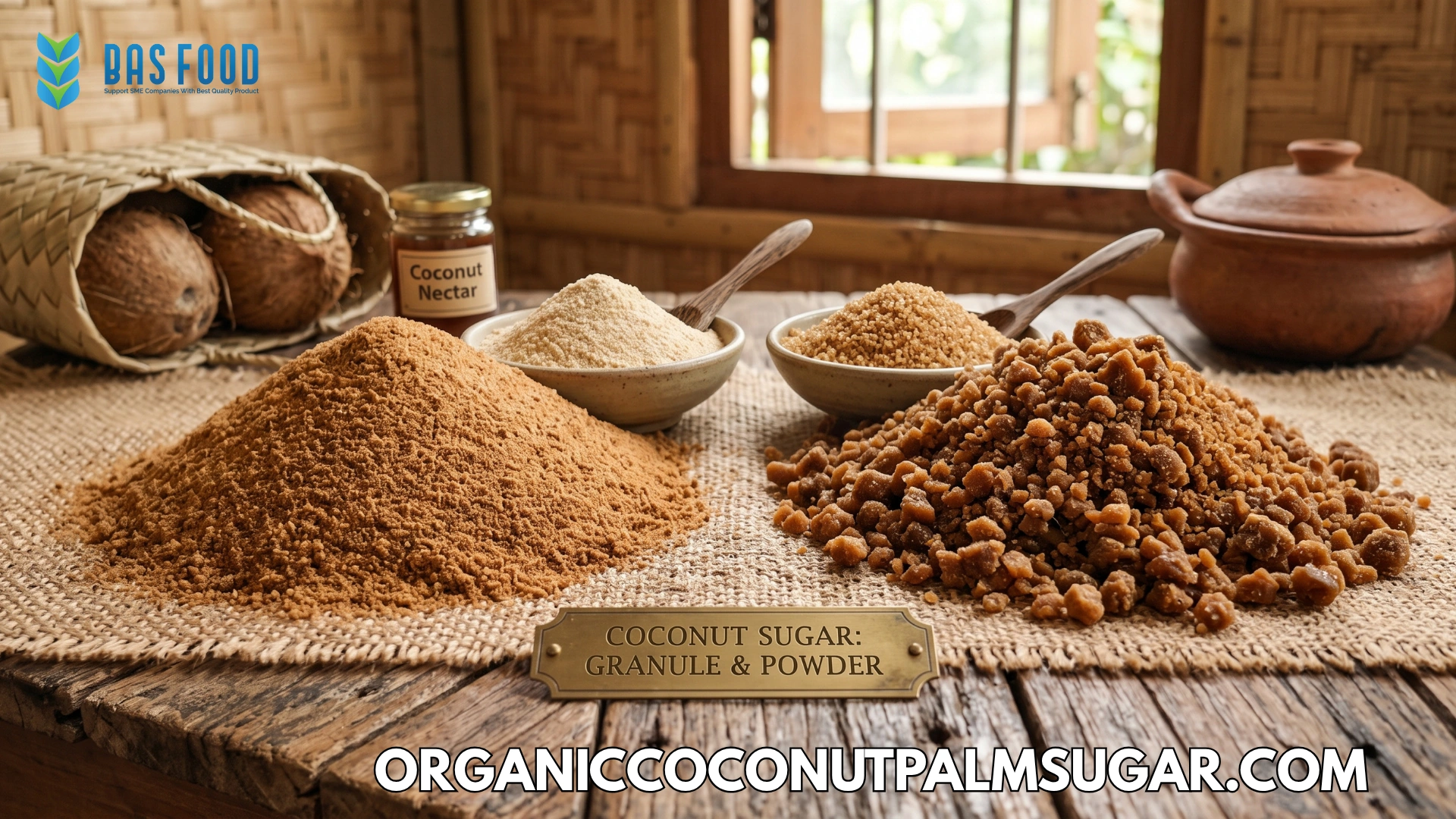
Coconut Sugar Granules vs Powder: What Is the Difference?
The main difference between coconut sugar granules and powder is particle size.
Coconut sugar granules are made up of relatively larger particles that can be seen and handled individually. Powder has much smaller particles and usually has a finer, more uniform appearance.
Both formats can be used as a sweetening ingredient, but they may behave differently during production. Granules can provide a distinct texture and may be easier to handle in certain applications. Powder can blend more easily into some formulations because of its finer structure.
However, the terms “granules” and “powder” do not always represent exactly the same particle size across different suppliers.
Why Particle Size Matters
B2B buyers should look beyond the product name.
If a manufacturer needs a particular particle size, the supplier should provide a clear specification. This can help the buyer determine whether the product is suitable for the intended process.
For example, a company producing instant coffee may require a finer product, while a bakery could prefer larger granules for a particular recipe.
Therefore, the most important question is not simply whether a supplier sells granules or powder. It is whether the available particle size matches the buyer’s production requirements.
What Are Coconut Sugar Granules?
Coconut sugar granules are a loose, granular form of coconut sugar.
The particles are larger than fine powder and can vary in size depending on the processing method and product specification.
This format is popular because it offers a balance between traditional coconut sugar and finely processed sugar. It remains easy to measure while still providing a noticeable granulated texture.
For B2B applications, granules can be useful across several food and beverage categories.
Common Uses of Coconut Sugar Granules
Coconut sugar granules can be considered for:
- Coffee
- Tea
- Bakery products
- Cookies
- Desserts
- Breakfast foods
- Granola
- Food mixes
- Sauces
- Retail sweeteners
- Foodservice applications
Granules can also work well for businesses that want a granulated sweetener rather than a fine powder.
The ideal size will depend on the specific recipe and production process.
What Is Coconut Sugar Powder?
Coconut sugar powder is a finer form of coconut sugar.
The smaller particles give the product a powder-like appearance and can make it useful for applications that require easy blending.
Powder is particularly interesting for manufacturers producing dry mixes, instant beverages, bakery products, confectionery products, and other formulated foods.
Because the particles are small, they can distribute more evenly through certain dry ingredient systems.
Where Coconut Sugar Powder Works Well
Common applications include:
- Instant coffee
- Tea mixes
- Powdered beverages
- Bakery mixes
- Cakes
- Biscuits
- Desserts
- Chocolate formulations
- Dry food blends
- Nutritional food products
- Retail sweetener products
However, suitability always depends on the exact product specification.
A very fine product may behave differently from a slightly coarser powder. Therefore, buyers should request samples and technical information before making a commercial decision.
Coconut Sugar Granules vs Powder for Food Manufacturing
Food manufacturing is one of the areas where the difference between granules and powder becomes particularly important.
Industrial production often relies on consistent ingredient flow, weighing, mixing, dosing, and processing. A product that performs well in one system may not perform the same way in another.
Granules may be suitable for production systems designed to handle larger particles. Powder can be more practical for certain dry blending applications.
Production Efficiency Matters
Manufacturers should consider how the sugar enters their production process.
Ask questions such as:
- Is the ingredient added manually?
- Is it automatically dosed?
- Does it need to blend with other dry ingredients?
- Will it be dissolved?
- Does the production line require a specific particle size?
- Will the ingredient be stored in bulk?
- Does the product need to flow through equipment?
These questions can help identify the better format.
A product that saves time during production may provide better overall value even if its purchase price is slightly higher.
Granules vs Powder for Coffee and Tea
Coffee and tea manufacturers have specific requirements because sugar needs to mix effectively with beverages.
Coconut sugar granules can work well in hot coffee and tea because heat can help the sugar dissolve.
However, the size of the granules can influence how quickly they dissolve.
Powder may offer an advantage when the formulation requires fast and even blending, particularly in instant drink mixes.
Hot Beverages vs Instant Mixes
A café serving traditional coffee may have no problem using granules.
A manufacturer producing instant coffee sachets may prefer a finer format that can blend with coffee powder and other dry ingredients.
Similarly, a tea company may select powder for an instant tea product but use granules for a retail jar designed for consumers to add to freshly brewed tea.
The final application should guide the decision.
Granules vs Powder for Baking
Baking is another application where both formats can work.
Coconut sugar granules can provide a slightly more noticeable texture and may be suitable for cookies, cakes, granola, and other baked products.
Powder can blend more easily into some dry formulations.
For example, a baking mix manufacturer may prefer powder because it can be distributed through flour and other dry ingredients.
The Recipe Determines the Best Format
There is no universal rule.
If a recipe requires a smooth and even distribution of sweetener, powder may be a practical choice.
If the product benefits from a more noticeable sugar texture, granules may be preferable.
The best approach is to conduct a trial using the actual recipe.
This helps manufacturers evaluate flavor, color, texture, mixing, and final product performance.
Dissolution and Mixing: Granules vs Powder
One of the most important practical differences between granules and powder is how they interact with liquids.
Smaller particles generally have more surface area relative to their volume, which can help them disperse or dissolve more quickly under suitable conditions.
Larger granules may require more mixing or stirring.
However, dissolution also depends on temperature, liquid volume, formulation, and the characteristics of the specific coconut sugar.
Why Testing Is Important
A buyer should avoid assuming that all coconut sugar powder will dissolve instantly or that all granules will dissolve slowly.
The actual product specification matters.
A beverage manufacturer should test both formats under real production conditions.
For example, test the product in hot coffee, cold beverages, or an instant drink formulation depending on the intended application.
The results will provide a much more useful answer than comparing the products by appearance alone.
Texture and Sensory Experience
Texture is another reason to consider coconut sugar granules vs powder carefully.
Granules can create a more noticeable physical presence in some products.
Powder tends to integrate more smoothly into many formulations.
For food manufacturers, this difference can influence the finished product.
For example, a granola manufacturer may want visible sugar particles, while a powdered beverage manufacturer may prefer a fine ingredient that disappears into the mixture.
Flavor Is Not the Only Factor
When evaluating samples, buyers should consider:
- Sweetness
- Aroma
- Color
- Texture
- Particle size
- Dissolution
- Mixing performance
- Final product appearance
Coconut sugar can contribute more than sweetness to a formulation.
Its characteristic flavor and color may also influence the finished product.
Therefore, sensory testing should form part of the product-development process.
Moisture and Storage Considerations
Moisture management is important for both granules and powder.
Coconut sugar can absorb moisture when exposed to humid conditions, so packaging and storage need attention.
Powder can be particularly sensitive to handling conditions because its smaller particles can interact more readily with surrounding moisture.
Granules also require protection, especially during long-distance transportation.
Proper Packaging Helps Protect the Product
B2B buyers should discuss packaging requirements with their supplier.
Important considerations include:
- Food-grade packaging
- Moisture protection
- Inner bags
- Outer cartons
- Bulk sacks
- Retail pouches
- Sealing
- Storage conditions
- Shipping environment
For international shipments, the packaging should be suitable for the expected transportation and storage conditions.
A good product can still develop handling problems if it is poorly packaged.
Coconut Sugar Granules vs Powder for Retail Products
Retailers have a different set of priorities.
Consumers often want an ingredient that is easy to use, store, and measure.
Coconut sugar granules can be attractive because they look like conventional granulated sugar while offering the distinctive appearance of coconut sugar.
Powder can provide a finer texture and may be suitable for baking-focused products or instant formulations.
Packaging and Positioning
The choice between granules and powder can influence how a product is positioned.
A retail brand may market granules as an everyday sweetener for coffee, tea, cooking, and baking.
A powder product could be positioned toward baking, beverage mixes, or specialized food applications.
Neither format is automatically better.
Packaging, branding, product quality, origin information, and target market all contribute to the customer’s purchasing decision.
Which Format Is Easier to Handle?
Handling depends on the workplace.
Granules are generally easy to scoop, measure, and transfer when the packaging protects them from excessive moisture.
Powder can also be easy to measure but may require more attention to dust, clumping, and moisture during certain handling conditions.
For industrial environments, equipment compatibility should be considered.
Manual vs Automated Handling
A small food business that adds sugar manually may have little difference between the two formats.
A large production facility, however, may use automated feeders or dosing systems.
In that situation, particle size can influence how the ingredient moves through the equipment.
This is why production trials are valuable.
Before placing a large order, manufacturers should test the actual product in their own system.
Fine Powder vs Granules for Blending
Dry blending is common in food manufacturing.
Companies may combine coconut sugar with flour, cocoa, coffee, spices, milk powder, or other ingredients.
Powder can be useful for these applications because its small particles may distribute easily through the dry mixture.
Granules can still work, but the mixing process may need to account for particle size differences.
Prevent Uneven Distribution
If different ingredients have significantly different particle sizes or densities, they may not distribute evenly during mixing.
This can affect the consistency of individual servings.
Therefore, manufacturers should test the complete formulation rather than evaluating coconut sugar in isolation.
A well-designed production trial can reveal whether granules or powder provide the best result.
Coconut Sugar Granules vs Powder for Export
International buyers also need to think beyond the ingredient itself.
Export orders often involve larger quantities, longer transportation distances, and multiple stages of handling.
Packaging, palletization, labeling, and storage conditions become important.
Both granules and powder can be prepared for export, but the packaging configuration may differ.
What Importers Should Confirm
Before placing an international order, buyers should confirm:
- Product format
- Particle size
- Moisture specification
- Packaging type
- Net weight
- Carton or bag dimensions
- Pallet configuration
- Minimum order quantity
- Production lead time
- Export documentation
- Storage requirements
Clear communication at the beginning can prevent problems later.
How to Choose the Right Coconut Sugar Supplier
Selecting the right coconut sugar supplier is just as important as choosing the product format.
A reliable supplier should understand the differences between granules and powder and be able to provide appropriate product information.
Buyers should ask for product specifications and, when possible, samples.
Questions to Ask Suppliers
Before ordering, consider asking:
- What particle sizes are available?
- Do you offer both granules and powder?
- Can you provide product samples?
- What are the moisture specifications?
- What packaging options are available?
- What is the minimum order quantity?
- Can you support regular bulk orders?
- What is the production lead time?
- Can you prepare export packaging?
- Can you provide relevant product documentation?
These questions help buyers compare suppliers based on more than price.
The Role of a Coconut Sugar Mould Supplier
Granules and powder are not the only product formats available.
Some buyers prefer moulded coconut sugar for traditional food products, specialty retail, or foodservice.
In this situation, a coconut sugar mould supplier can become relevant.
Moulded coconut sugar can be produced in different shapes and sizes depending on the product concept and production capabilities.
When Moulded Sugar Makes Sense
Moulded coconut sugar may be worth considering when:
- Solid pieces are required.
- Traditional presentation is important.
- The product will be portioned by piece.
- A specialty retail format is desired.
- Custom shapes are part of the product concept.
The key is to select a format that fits the final application.
There is no reason to choose powder simply because it is easier to handle if the finished product requires solid sugar pieces.
CV Bonafide Anugerah Sentosa as an Indonesian Coconut Sugar Supplier
For international buyers looking for Indonesian coconut sugar, supplier selection should include product quality, communication, packaging, and export capability.
CV Bonafide Anugerah Sentosa is an Indonesian exporter and supplier of coconut sugar and other coconut-derived products.
B2B buyers can communicate their intended application and product requirements when discussing potential supply.
Start With Your Requirements
A buyer can make the process more efficient by explaining exactly what is needed.
For example:
“We need coconut sugar granules for retail coffee and tea.”
Or:
“We need fine coconut sugar powder for an instant beverage.”
Or:
“We need moulded coconut sugar for a traditional food product.”
This information helps the supplier understand the application and recommend a suitable format.
Cost: Is Powder More Expensive Than Granules?
Price comparisons should be made carefully.
The cost of coconut sugar depends on several factors, including product specifications, processing, packaging, order quantity, and other commercial conditions.
A powder product may involve additional processing compared with a larger granulated format.
However, the lowest purchase price does not necessarily represent the lowest overall cost.
Consider Total Production Cost
Manufacturers should consider:
Ingredient price + processing + handling + packaging + storage + production efficiency.
For example, if powder eliminates an additional grinding or preparation step, it could provide value even when its purchase price is higher.
On the other hand, if a production line is already designed to handle granules, purchasing a finer product may provide little benefit.
The best purchasing decision considers the complete production process.
Final Thoughts: Choose the Format That Fits the Job
The comparison between coconut sugar granules vs powder does not have a single winner.
Granules can be a practical choice for everyday sweetening, retail products, foodservice, and applications where a noticeable granular texture is acceptable.
Coconut sugar powder can be a better fit for dry blends, instant beverages, baking mixes, and food manufacturing processes that require finer particles.
The right decision depends on your product, production system, packaging, target customer, and purchasing requirements.
For B2B buyers, the best approach is to define the required specifications first, request samples, conduct application testing, and then compare suppliers.
If you are sourcing from Indonesia, CV Bonafide Anugerah Sentosa can be considered as a potential coconut sugar supplier for international B2B requirements.
Whether you ultimately choose granules, powder, or a moulded format, the goal remains the same: find a coconut sugar product that performs consistently, fits your production process, and provides good value throughout the supply chain.