As consumers continue to move away from highly refined sweeteners, food manufacturers are searching for ingredients that align with clean-label trends and natural food preferences. This shift has created growing demand for coconut-based sweeteners, particularly coconut treacle and coconut sugar. While both products originate from coconut blossom sap, they differ in texture, processing methods, applications, and market positioning. As a result, many importers, distributors, and food manufacturers frequently ask the same question: when comparing coconut treacle vs coconut sugar, which option is the better choice?
The answer depends largely on the intended application, target market, product formulation, and customer expectations. Both products offer unique advantages and serve different functions within the food industry.
In this guide, we will explore the key differences between coconut treacle and coconut sugar, their production methods, commercial applications, and why both continue to gain popularity as premium coconut sweeteners and natural sugar alternatives in global markets.
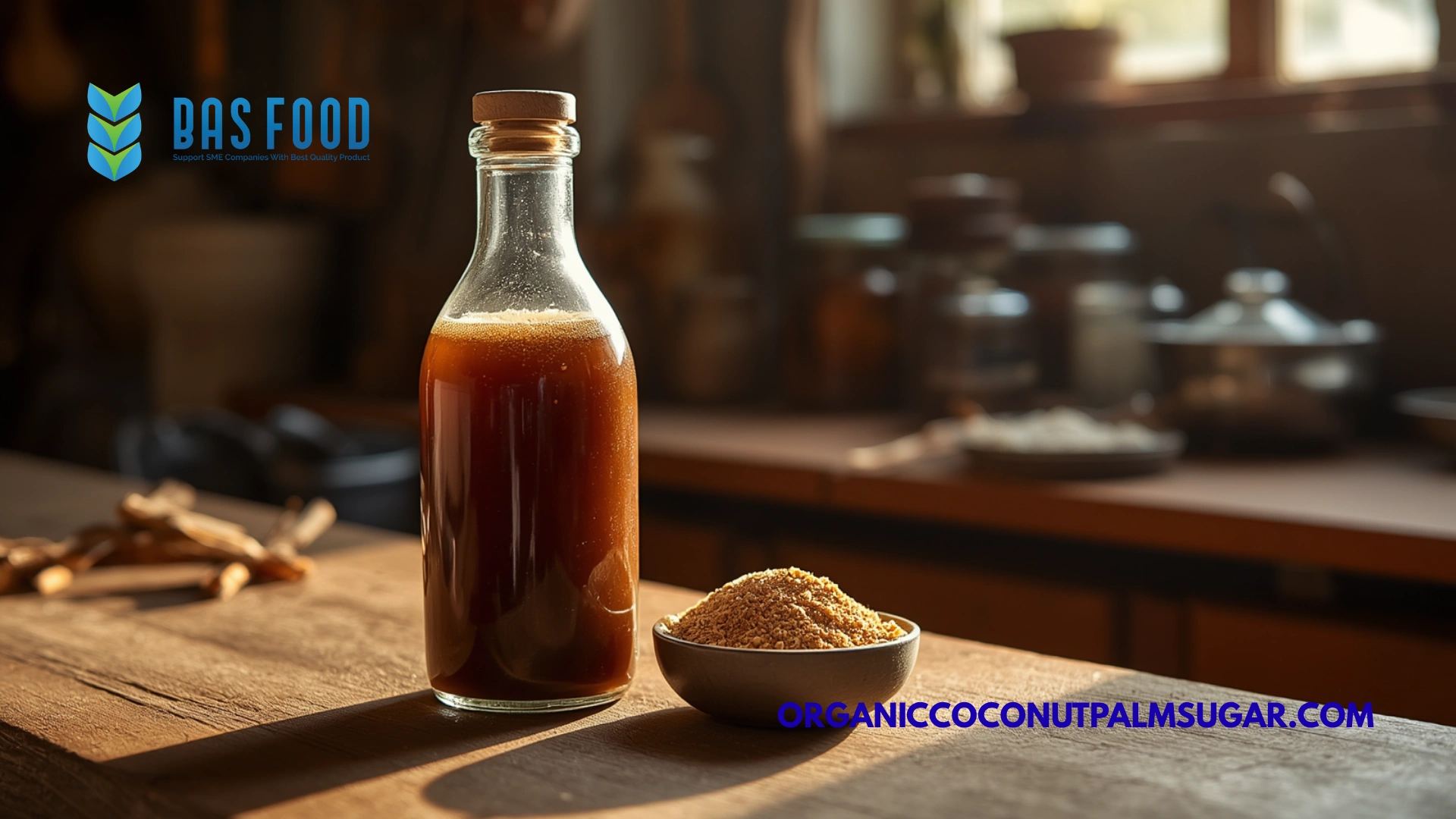
What Is Coconut Treacle?
Coconut treacle is a thick, golden-brown syrup produced by concentrating fresh coconut blossom sap through controlled heating.
The process begins with harvesting sap from coconut flower stalks. Farmers carefully collect the sap before the flowers develop into mature coconuts. The sap is then filtered and slowly heated to remove water content while concentrating the natural sugars.
The final product is a rich syrup with a smooth texture and deep flavor profile. Many people describe coconut treacle as having mild caramel, toffee, and molasses-like notes.
Because it remains in liquid form, coconut treacle is widely used in beverages, sauces, marinades, bakery fillings, and specialty food products where liquid sweeteners are preferred.
Its distinctive flavor and versatility have helped coconut treacle gain attention among food innovators seeking premium natural ingredients.
What Is Coconut Sugar?
Coconut sugar begins with the same raw material: coconut blossom sap.
However, the production process continues beyond syrup formation. After the sap is concentrated, additional evaporation removes nearly all remaining moisture.
The resulting thick concentrate eventually crystallizes into solid sugar granules.
Once dried and processed, coconut sugar can be packaged in powdered, granulated, or block form depending on customer requirements.
Coconut sugar offers a flavor profile similar to brown sugar with subtle caramel notes. Because it resembles conventional sugar in appearance and functionality, manufacturers can often integrate it into existing formulations with minimal adjustments.
Today, coconut sugar is used extensively in bakery products, confectionery, beverages, cereals, snack foods, and retail sweetener products.
Coconut Treacle vs Coconut Sugar: Understanding the Main Differences
Although both products come from coconut sap, several important differences separate them.
Texture
The most obvious distinction in the coconut treacle vs coconut sugar comparison is texture.
Coconut treacle remains a thick liquid syrup.
Coconut sugar is a dry crystalline sweetener.
This difference significantly affects how manufacturers use each ingredient.
Moisture Content
Coconut treacle retains some moisture, giving it its syrup consistency.
Coconut sugar undergoes further drying to create a shelf-stable granular product.
Processing Time
Producing coconut sugar generally requires additional processing stages beyond those used for coconut treacle.
This extended processing helps achieve crystallization and desired particle sizes.
Storage and Transportation
Coconut sugar is often easier to transport and store due to its dry form.
Meanwhile, coconut treacle may require more attention to packaging and storage conditions.
These distinctions influence purchasing decisions depending on manufacturing requirements.
Production Process: How Both Coconut Sweeteners Are Made
The production journey for both products starts in the same place.
Farmers harvest fresh sap from coconut flower blossoms using traditional tapping techniques passed down through generations.
The collected sap is transported to processing facilities where filtration removes natural impurities.
At this point, the production pathways begin to diverge.
Coconut Treacle Production
For coconut treacle, producers continue controlled heating until the sap reaches the desired syrup consistency.
The finished product is then cooled, filtered if necessary, and packaged.
Coconut Sugar Production
For coconut sugar, producers continue evaporating moisture until a concentrated mass forms.
This material is then cooled, granulated, dried, and sometimes sieved to achieve uniform particle size.
While both products share a common origin, their final forms differ significantly because of these processing variations.
Flavor Profile Comparison
Flavor plays an important role when selecting ingredients for product development.
In the coconut treacle vs coconut sugar discussion, flavor differences can influence application suitability.
Coconut Treacle Flavor
Coconut treacle typically offers:
- Rich sweetness
- Caramel notes
- Mild molasses characteristics
- Smooth syrup mouthfeel
These qualities make it particularly appealing in premium beverages and specialty foods.
Coconut Sugar Flavor
Coconut sugar generally provides:
- Mild sweetness
- Light caramel flavor
- Brown sugar-like characteristics
- Neutral versatility
Its flavor profile allows it to function effectively across a wide range of food applications.
For manufacturers, selecting the right option depends on the desired taste experience.
Commercial Applications of Coconut Treacle
Coconut treacle performs exceptionally well in products that benefit from liquid sweeteners.
Beverage Industry
Manufacturers use coconut treacle in:
- Coffee beverages
- Tea products
- Smoothies
- Functional drinks
- Craft beverages
Its liquid consistency simplifies blending and formulation.
Sauces and Condiments
The syrup texture works well in:
- Marinades
- Dressings
- Barbecue sauces
- Gourmet condiments
- Specialty Foods
Premium food brands often use coconut treacle to create unique flavor profiles and differentiate their products.
Its rich taste can add value to specialty product lines.
Commercial Applications of Coconut Sugar
Coconut sugar offers greater flexibility in dry product formulations.
Bakery Products
Manufacturers commonly use coconut sugar in:
- Cookies
- Cakes
- Muffins
- Bread products
- Pastries
- Snack Foods
Coconut sugar appears in:
- Granola
- Energy bars
- Protein snacks
- Breakfast cereals
- Retail Sweeteners
Many consumers purchase coconut sugar as a direct substitute for conventional sugar.
This retail demand continues driving growth worldwide.
The versatility of coconut sugar makes it one of the most widely used natural sugar alternatives available today.
Market Trends Driving Demand for Coconut Sweeteners
The global sweetener market continues evolving.
Consumers increasingly seek ingredients that appear natural, minimally processed, and sustainably sourced.
This trend has contributed to growing demand for premium coconut sweeteners.
Several factors support continued market growth:
Clean Label Demand
Consumers want recognizable ingredients with simple origins.
Plant-Based Food Growth
Plant-based product categories continue expanding globally.
Premium Product Positioning
Natural sweeteners help brands differentiate themselves from competitors.
Sustainable Sourcing
Many buyers value ingredients linked to renewable agricultural systems.
These trends create opportunities for both coconut treacle and coconut sugar producers.
Which Product Is Better for Manufacturers?
There is no universal winner in the coconut treacle vs coconut sugar comparison.
Instead, the best choice depends on product requirements.
Choose coconut treacle when:
- A liquid sweetener is needed
- Rich flavor is desired
- Beverage applications are involved
- Premium positioning is important
Choose coconut sugar when:
- Dry formulations are required
- Easy storage is preferred
- Traditional sugar replacement is needed
- Broad application flexibility is important
Many manufacturers actually use both ingredients across different product lines.
This approach allows them to maximize formulation flexibility while meeting diverse customer preferences.
Why Indonesia Is a Leading Source of Coconut Sweeteners
Indonesia is one of the world’s largest coconut-producing countries.
Its tropical climate supports year-round coconut cultivation, providing a reliable supply of raw materials for both coconut treacle and coconut sugar production.
Millions of coconut trees support extensive agricultural networks throughout the country.
Indonesian producers combine traditional harvesting knowledge with modern manufacturing practices to produce high-quality coconut sweeteners for export markets.
Strong export infrastructure, competitive production costs, and abundant raw material availability have helped Indonesia become a leading global supplier.
Partner with a Trusted Indonesian Coconut Sweetener Exporter
For importers, distributors, and food manufacturers seeking reliable sourcing partners, selecting an experienced exporter is essential.
CV Bonafide Anugerah Sentosa supplies premium coconut treacle, coconut sugar, organic coconut sugar, coconut nectar, virgin coconut oil, coconut milk products, coffee, spices, and fishery products to international markets.
The company works closely with trusted producers and farming communities to ensure product consistency, reliable supply, and export-ready quality.
Through strong sourcing networks and export expertise, CV Bonafide Anugerah Sentosa helps global buyers access premium Indonesian coconut products that meet international market requirements.
Conclusion
The discussion of coconut treacle vs coconut sugar is not about determining a single winner. Instead, it is about understanding which product best supports specific manufacturing goals.
Both products originate from coconut blossom sap and belong to the growing category of premium coconut sweeteners. However, differences in texture, processing, flavor, storage, and functionality make each product suitable for different applications.
As demand for natural sugar alternatives continues to grow worldwide, both coconut treacle and coconut sugar are expected to play increasingly important roles in food innovation, clean-label product development, and sustainable ingredient sourcing.
For businesses seeking high-quality coconut sweeteners, Indonesia remains one of the most reliable sourcing destinations in the global market.